The top customer service chatbots in 2026 are really AI agents: they answer from your knowledge base, take actions like order lookups and bookings, and hand off to a person with context. For enterprise customer service, the main contenders are Salesforce Agentforce, Zendesk AI agents, Intercom Fin, Sierra, Google’s CX Agent Studio and Microsoft Copilot Studio. For small and mid-sized teams, HubSpot’s Customer Agent, Freshdesk, Gorgias and Tidio’s Lyro are common choices. Which one is “best” depends mostly on the help desk and CRM you already use. Below are the ten, compared only on what their own websites say, followed by the cases where a custom chatbot beats a platform.
How we compared them
- Public information only. Each description reflects the vendor’s own site as of the verification date. We haven’t run benchmark tests, and we don’t publish scores we can’t back up.
- No vendor’s statistics. Vendor sites are full of resolution-rate and ROI claims. We left them out because we can’t verify them; ask for references instead.
- No affiliation. We don’t take referral fees from any of these vendors.
Last verified: October 18, 2026. Products, names and plans change quickly. Google’s product, for example, now appears as “CX Agent Studio” under Gemini Enterprise for Customer Experience.
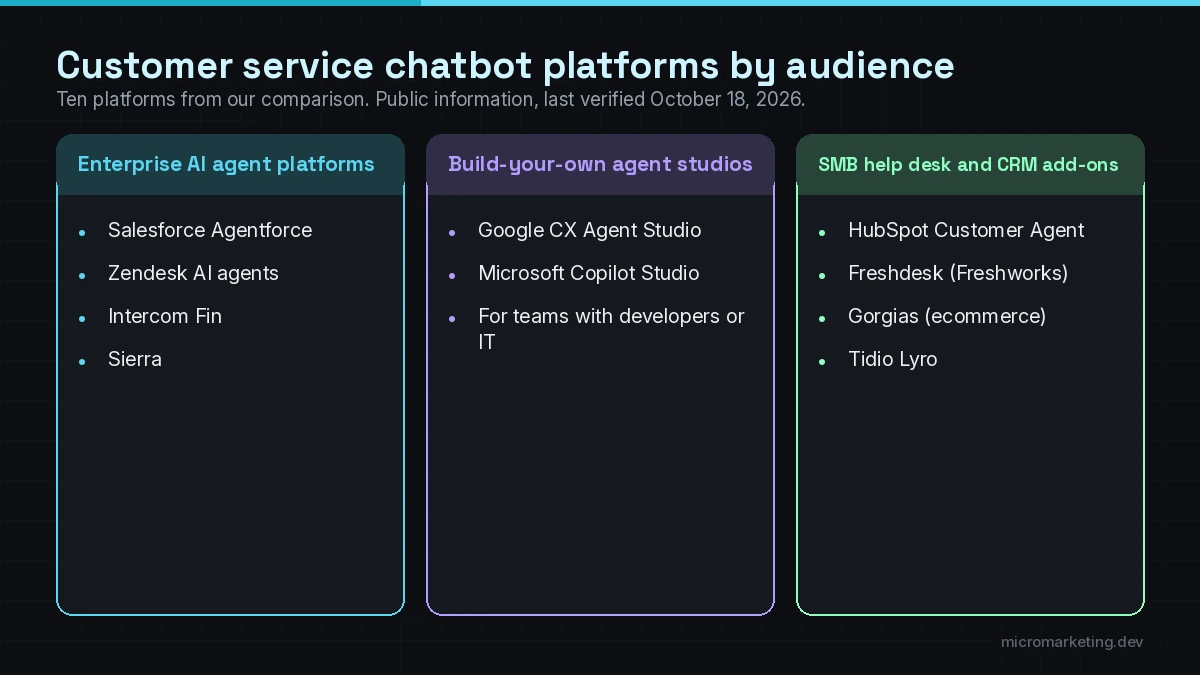
The 10 customer service chatbots
1. Intercom Fin
Intercom’s AI agent, marketed at fin.ai as a “Customer Agent” for service, sales, ecommerce and customer success. Its site lists voice, chat, email, social and Slack as channels, and says Fin works natively in the Intercom help desk and can be added to other help desks, including Salesforce, Freshdesk, HubSpot and Zendesk. Fits: teams that want a dedicated AI agent and may not want to switch help desks.
2. Zendesk AI agents
Zendesk positions its AI for customer service as part of an AI-first “Resolution Platform,” with AI agents that resolve issues autonomously across channels, a Copilot for human agents and a contact-center product. Fits: teams already on Zendesk, or enterprises that want help desk, AI agents and voice from one vendor.
3. Salesforce Agentforce
Salesforce describes Agentforce as an AI agent platform for 24/7 autonomous support at enterprise scale, on the web, by phone and in apps, with examples across customer service, contact center, field service, sales and IT. Fits: organizations already running on Salesforce that want agents working directly on their CRM data.
4. Sierra
Sierra builds AI agents for consumer brands. Its site says one agent can be deployed across chat, SMS, WhatsApp, email, voice and ChatGPT, and that it offers outcome-based pricing. Fits: large consumer brands that want a vendor-built, brand-specific agent.
5. Google CX Agent Studio
Google Cloud’s Customer Experience Agent Studio, part of Gemini Enterprise for Customer Experience, is a Gemini-powered platform for building, evaluating and deploying conversational agents in a visual interface. Google’s page mentions human-like voices in more than 40 languages and prebuilt agent templates. Fits: enterprises with in-house developers, especially on Google Cloud, building custom chat and voice agents.
6. Microsoft Copilot Studio
Microsoft describes Copilot Studio as a no-code platform for creating and managing custom agents, workflows and apps, with security, governance and compliance controls. Fits: organizations on Microsoft 365 that want IT-governed agents, including internal service desks.
7. HubSpot Customer Agent
HubSpot’s AI customer agent resolves questions, takes actions in the HubSpot CRM and hands off to your team with context. HubSpot’s page lists voice, email, chat, forms, WhatsApp and Facebook Messenger, and says it requires HubSpot’s Professional or Enterprise editions and runs on HubSpot Credits. Fits: small and mid-sized teams already using HubSpot Service Hub.
8. Freshdesk (Freshworks)
Freshworks positions Freshdesk as AI-powered customer service software combining AI agents, people and workflows, with an AI Copilot for human agents and email AI agents. It offers a free starting option. Fits: growing support teams that want help desk plus AI without an enterprise contract.
9. Gorgias
Gorgias calls itself a conversational AI platform for ecommerce, with an AI Agent, a help desk, voice and SMS, and integrations with Shopify, BigCommerce, Magento and WooCommerce. Fits: online stores, especially on Shopify, that want order-aware support.
10. Tidio Lyro
Tidio’s Lyro is an AI customer service agent that sits alongside Tidio’s live chat and help desk tools, with a free trial. Fits: small businesses and online shops that want website chat with AI answers at a low starting cost.
What to ask before you choose any of them
A quick filter that cuts the list fast:
- Which help desk and CRM do you already use? Native fit usually beats switching.
- Which channels matter? Website chat only, or also email, voice, SMS, WhatsApp and Messenger?
- Can it take actions, like order lookups, refunds within limits, bookings and CRM updates, or does it only answer questions?
- How does handoff work? Does the human see the full conversation? Can you set rules for when the bot steps aside?
- What’s the pricing unit? Per seat, per resolution, per conversation or credits? Model it against your real volume.
- How do you control what it says? Approved sources only, topics to avoid, tone, and an easy way to fix wrong answers.
- What data does it keep, and where? Especially if you’re in a regulated industry.
When a custom chatbot beats a platform
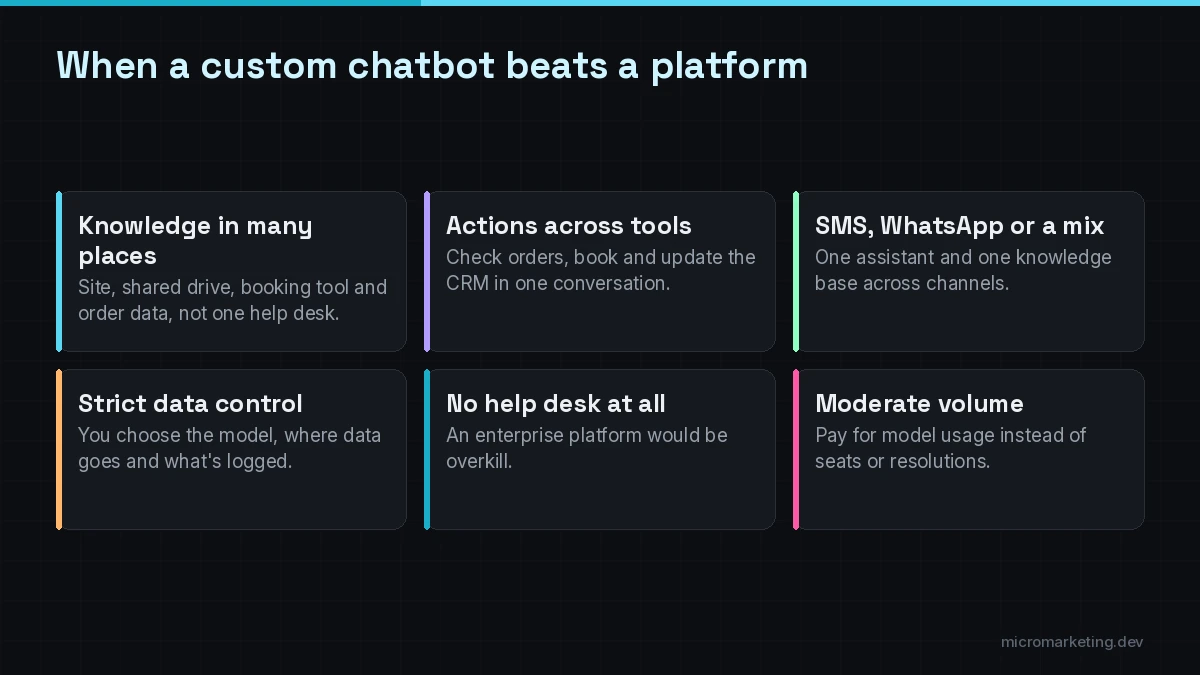
Platforms are great when your support already lives in one of them. A custom chatbot usually wins when:
- Your knowledge is spread across several systems, like your site, a shared drive, a booking tool and an order database, rather than one help desk.
- It needs to act across tools: check the order system, book in the calendar and update the CRM in one conversation.
- Your channels are SMS, WhatsApp or a mix, and you want one assistant with one knowledge base across all of them.
- You need tight control over which model is used, where data goes and what gets logged.
- You’re a small business without a help desk at all, and an enterprise platform would be overkill.
- You want a smaller monthly bill for moderate volume, paying for model usage instead of per-seat or per-resolution pricing.
That’s the work our custom AI chatbots grounded in your content service does: assistants for your website, SMS, WhatsApp and Messenger that answer from your approved pages, documents and FAQs, capture and qualify leads, and hand off to your team with the transcript. If customers mostly call rather than chat, look at our AI receptionist instead. For the WhatsApp rules your chatbot must follow, read what Meta business AI is allowed to do on WhatsApp. And if you’re comparing phone options too, see the best AI receptionist in 2026, or our wider AI automation services.
A quick rollout checklist, whichever you pick
- Start with your top questions and the content that answers them, cleaned up before the bot reads it.
- Launch on one channel first, usually website chat, and add channels once answers are reliable.
- Set the handoff rules before launch, and test them with real staff on the other end.
- Review conversations weekly for the first month and fix wrong answers at the source.
- Tell customers they’re talking to an AI assistant and how to reach a person.
The same checklist applies to the custom chatbots we build and to any platform on this list.
Frequently asked questions
What is the best chatbot for enterprise customer service?
There isn’t one best option. Enterprises usually choose the AI agent that fits their existing stack: Agentforce for Salesforce shops, Zendesk AI agents for Zendesk users, Intercom Fin as a help-desk-agnostic agent, and Google CX Agent Studio or Microsoft Copilot Studio for teams building custom agents.
What’s the difference between a chatbot and an AI agent for customer service?
A traditional chatbot follows scripted flows or answers FAQs. An AI agent understands free-form questions, answers from your knowledge base and can take actions like looking up an order or booking an appointment, then hands off to a person when needed.
Which customer service chatbot is best for a small business?
Start with what you already use. HubSpot users can look at HubSpot’s Customer Agent, Shopify stores at Gorgias, and teams wanting low-cost website chat at Tidio’s Lyro. If your support is spread across tools or channels like SMS and WhatsApp, a custom chatbot may fit better.
How much do customer service chatbots cost?
Pricing models vary: per seat, per resolution, per conversation or usage credits, sometimes with platform plan requirements. Model each option against your real monthly conversation volume before comparing.
Can a customer service chatbot hand off to a human?
The good ones can, and you should treat it as a requirement. Check that the human agent sees the full conversation and that you can set rules for when the bot hands off.
Not sure a platform fits?
Tell us where your support conversations happen today and which tools hold the answers. We’ll tell you whether a platform add-on or a custom chatbot makes more sense. Book a free strategy call. The first consult is free.
Newsletter
Get growth playbooks in your inbox.
Practical SEO, PPC, automation, and web strategy from the Micromarketing team. No fluff, unsubscribe anytime.