The best AI agent development services start with your process, not a model: they map the task, define what the agent may and may not do, prototype on your real data, launch with human approvals and monitor the agent after it goes live. When you compare providers, ask how they handle permissions, testing, failures, costs and ownership, and whether they’ll tell you when an agent is the wrong tool. This guide gives you a buyer’s checklist, the questions to ask, the red flags, and an honest comparison of freelancers, agencies and platforms. It doesn’t rank vendors, because a ranking can’t know your process.
First, decide whether you need an agent at all
A good provider will ask this before you do. Many jobs that sound like “AI agent” projects are better as:
- a plain workflow automation, when the steps never change (form to CRM to Slack alert),
- a chatbot, when the job is answering questions from approved content,
- a built-in agent in a tool you already pay for, when the job lives entirely inside that tool.
An agent earns its cost when the job crosses several tools, involves messy inputs (emails, documents, calls) and needs some judgment. If you’re unsure, our guide to AI agents for small business walks through the difference.
What a good AI agent development service includes
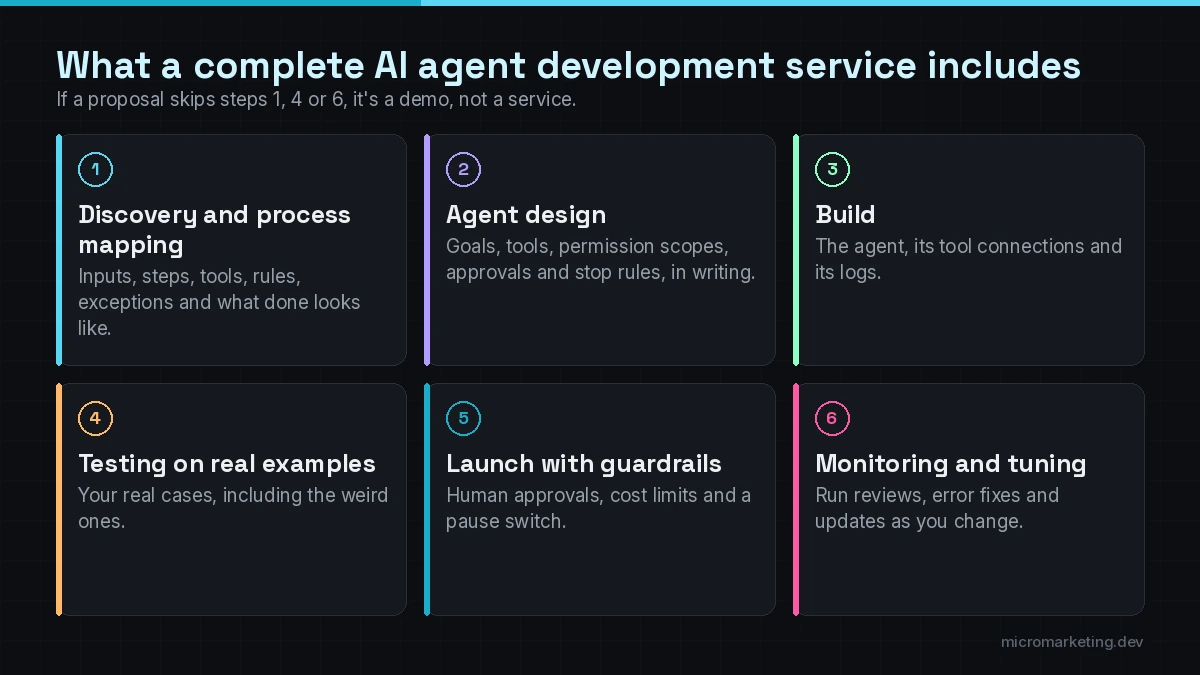
Whatever the provider calls it, the scope should cover six things:
- Discovery and process mapping. The provider documents the current process: inputs, steps, tools, decision rules, exceptions and what “done” looks like.
- Agent design. Goals, the tools the agent may use, permission scopes, approval points, fallbacks and stop rules, written down before anything is built.
- Build. The agent, its tool connections (CRM, email, calendar, internal APIs) and its logs.
- Testing on real examples. A set of real cases from your business, including weird ones, with results you can review.
- Launch with guardrails. Human approvals on anything customer-facing or financial, cost limits and a clear way to pause the agent.
- Monitoring and tuning. Someone watches the runs, reviews errors and updates the instructions and tools as your process changes.
If a proposal skips 1, 4 or 6, it’s a demo, not a service.
The buyer’s checklist
Use this list to compare proposals side by side.
Process and fit
- Did they ask about your process before talking about models?
- Did they say when an agent isn’t the right tool?
- Do they have a written definition of success for your project?
Safety and control
- Will the agent have the narrowest permissions it needs? Read-only first?
- Which actions need a human approval, and how does approval work day to day?
- How do they defend against prompt injection, where text inside an email or web page tries to hijack the agent? The OWASP Top 10 for LLM Applications lists prompt injection and “excessive agency” as top risks. Ask how each is handled.
- What’s logged, where, and for how long?
Quality
- How will they test the agent before launch? On what data?
- What happens when the agent is unsure? Does it hand off with context?
- How will you know if quality drops after launch?
Cost
- What are the build costs and the running costs (model usage, hosting, tools)?
- Are there usage limits so a runaway loop can’t run up a bill?
- What does ongoing support cost, and what’s included?
Ownership and handover
- Who owns the code, prompts, workflows and accounts?
- Is there documentation your team (or another provider) could pick up?
- Can you switch models or providers later without starting over?
Data
- Where does your data go, and which model providers see it?
- Do the providers’ terms allow your data to be used for training? Can that be turned off?
- If you’re in a regulated industry, how do they handle it?
Questions to ask on the first call
Short version for the meeting:
- “Walk me through how you’d map this process before building.”
- “What would this agent be allowed to do, and what would it never be allowed to do?”
- “Show me how you test an agent before launch.”
- “What happens on the agent’s first bad day?”
- “What will this cost to run each month, and how do you cap it?”
- “If we part ways, what do we keep?”
Good providers answer these concretely. Vague answers about “cutting-edge AI” are a signal.
Red flags
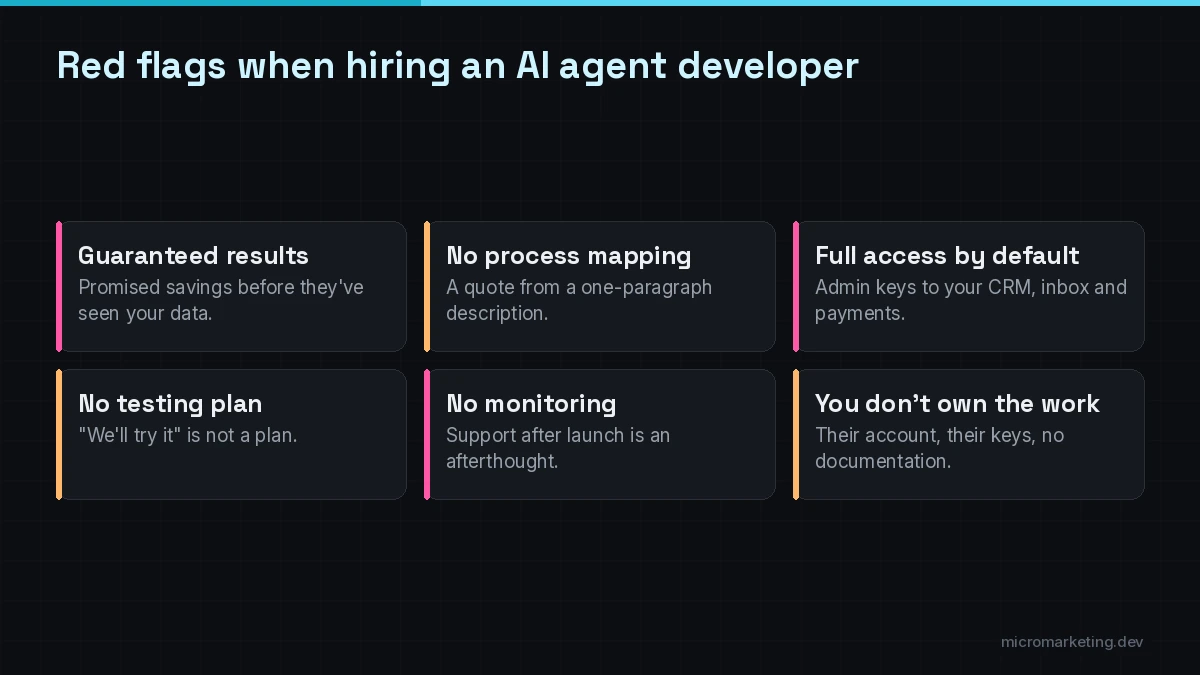
- Guaranteed results (“cut support costs in half”) before they’ve seen your data.
- No discovery: they quote a price from a one-paragraph description.
- Full access by default: admin keys to your CRM, inbox and payments “to keep it simple.”
- No testing plan beyond “we’ll try it.”
- No monitoring after launch, or support that’s an afterthought.
- Lock-in: the agent runs in their account, on their keys, with no documentation.
- Invented proof: case studies with no names, round-number results and no way to verify them.
Freelancer, agency or platform?
There are three common ways to get an agent built. Each has a place.
Freelance developer
- Good for: a well-defined, single-tool build, when you can manage the project yourself.
- Watch for: availability after launch, documentation, and whether they cover security and testing, not just the code.
AI agent development agency
- Good for: agents that cross several tools, need process mapping, or need ongoing monitoring and tuning.
- Watch for: agencies that resell one platform for every problem, or that can’t explain their guardrails.
Platform with built-in agents (your CRM, help desk or a business AI workspace)
- Good for: jobs that live inside that platform, when you’re happy with its rules and data handling.
- Watch for: limits on cross-tool actions, pricing that scales with usage, and less control over approvals.
Many businesses combine them: a platform’s built-in agent for in-tool tasks, and a custom build for the cross-tool workflow that actually moves the needle.
Do you need an AI agent development company in the USA?
Searches for “AI agent development services in USA” are often about data, contracts and time zones, not code. A US-based provider can make contracts, support hours and data conversations easier, but location doesn’t replace the checklist above. Ask where data is processed and stored regardless of where the team sits. We’re based in Boca Raton, Florida, and build agents for teams across the US.
How we work
Our AI agent development service follows the same steps we’d ask you to look for: map the process, prototype on your real data, launch with guardrails and approvals, then measure and improve. We name the tools we build on (OpenAI’s Agents SDK, Grok, open-source agents like Hermes Agent, and n8n for orchestration) and pick per task. For background on the platforms, see GPT agents vs OpenAI AgentKit. For the full range of what we build, see our AI automation services. And if your team wants a risk framework to go with the build, the NIST AI Risk Management Framework is free and practical.
Frequently asked questions
What should an AI agent development service include?
At minimum: discovery and process mapping, agent design with permissions and approvals, the build and integrations, testing on your real examples, a guarded launch, and monitoring and tuning after launch.
How do I compare AI agent development companies?
Use the same checklist for each: how they map your process, how they limit permissions, how they test, what it costs to run, who owns the work, and how they handle your data. Ask each to walk you through a past build’s guardrails, not just its demo.
How long does it take to build an AI agent?
It depends on the number of tools, approvals and edge cases. A reliable provider gives a timeline after discovery, not before, and plans a prototype phase on real data before full launch.
Should I hire a freelancer or an agency for AI agent development?
A freelancer can work for a well-defined, single-tool build you can manage yourself. An agency fits better when the agent crosses several systems, needs process mapping, or needs ongoing monitoring and tuning.
Who owns an AI agent after it’s built?
That’s set by your contract, so ask before you sign. You should own your data, the workflows and the prompts, and have documentation that lets another team maintain the agent.
Bring us the task, we’ll bring the checklist
Tell us the job you want an agent to take on. We’ll walk through the same checklist with you and say plainly whether an agent, a simpler workflow or a built-in tool is the right call. Book a free strategy call. The first consult is free. You can also review how our AI agent development service works before the call.
Newsletter
Get growth playbooks in your inbox.
Practical SEO, PPC, automation, and web strategy from the Micromarketing team. No fluff, unsubscribe anytime.