GoHighLevel is a bundled, flat-priced platform that puts CRM, calling, texting, calendars, funnels and automation in one place for local and service businesses; HubSpot is a modular suite that starts with a free CRM and grows hub by hub into an enterprise system. For a small business the choice comes down to how you win customers. If your pipeline runs on phone calls, texts and booked appointments, GoHighLevel’s bundle is usually the better fit and the simpler bill. If you sell through email, content and a sales team that needs deep reporting, HubSpot’s depth is worth its structure. Below, we compare the two on the things a small business actually uses, then give you a checklist to decide.
What each platform is built for
GoHighLevel was built for agencies serving local businesses, and the product reflects that. One account includes a CRM with pipelines, a conversation inbox for SMS, email, calls and social messages, calendars with booking pages, funnel and website builders, workflow automation, reputation management and reporting. Pricing is a flat monthly plan, with calling and texting usage on top. See GoHighLevel’s pricing for the current plans.
HubSpot was built as an inbound marketing platform and grew into a full suite. The CRM is free, and you add Marketing Hub, Sales Hub, Service Hub, Content Hub, Operations Hub and others at Starter, Professional or Enterprise tiers. Pricing scales with tiers, seats and marketing contacts. See HubSpot’s CRM pricing.
The design difference matters more than any single feature. GoHighLevel assumes you want everything in one box and will use most of it. HubSpot assumes you’ll start small and buy capability as you grow.
Pricing model: flat bundle vs modular hubs
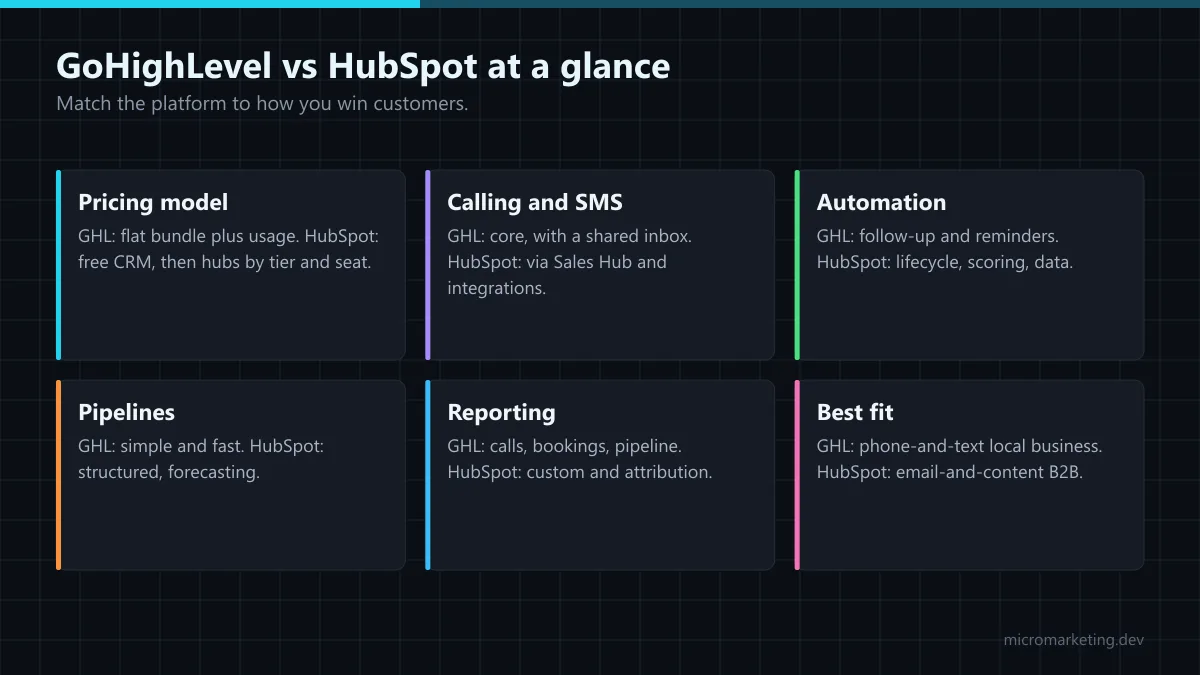
We won’t quote prices that will be out of date next quarter; both companies change them. The models are what you need to understand.
GoHighLevel: a flat monthly subscription per account covers the platform. Calling, SMS and email sending are usage-billed on top (usually through built-in telephony and email services), and some AI features are metered. For a business that uses the whole bundle, the predictable base price is a strength.
HubSpot: free CRM to start, then paid hubs. Marketing Hub pricing rises with marketing contacts. Sales Hub and Service Hub are priced per seat at higher tiers. Professional tiers often carry onboarding fees. For a business that only needs one hub at Starter, HubSpot can be inexpensive. For a business that needs Marketing and Sales at Professional, the bill climbs quickly.
The practical test: list the features you’ll use in year one, price them on both platforms at your contact count and seat count, and include usage. The flat bundle often wins for local service businesses; the modular model often wins for lean B2B teams that only need one hub.
Calling, texting and the conversation inbox
This is the clearest difference for local businesses.
GoHighLevel treats phone and text as core. You get business numbers, two-way SMS, call tracking and recording, a shared inbox that merges texts, emails, calls and social messages per contact, and workflow triggers on call and message events. Missed-call text-back is a few clicks. Appointment reminders by text are standard.
HubSpot includes calling with Sales Hub and supports SMS through its marketing tools and partner integrations, with limits that depend on tier. The experience is built around email first, with calling and SMS as additions. It works, but it isn’t the center of the product.
If your customers text you and you text them, GoHighLevel’s inbox is a different experience. We describe how we set up that flow in missed-call text-back for a local business.
Automation: workflows on both sides
Both platforms have visual workflow builders with triggers, conditions, delays and actions.
GoHighLevel workflows are strong on communication: send a text, send an email, make a call, book or move an appointment, update a pipeline stage, add a tag, notify a user, and wait for a reply. They’re built for follow-up sequences, reminders, review requests and lead routing. AI steps for replies and conversation handling are available and metered.
HubSpot workflows are strong on data and lifecycle: enroll by property, branch by score, update records across objects, rotate owners, create tasks, and trigger from almost any property change. At Professional tier and above the logic is deeper, and Operations Hub adds data sync and custom code actions.
For “text the lead in two minutes, call in five, text again tomorrow,” GoHighLevel is more direct. For “score this lead from behavior across email, site visits and deals, then route by territory,” HubSpot is more capable. Many of our clients run GoHighLevel for the customer-facing side and connect it to other systems with n8n workflow automation when they need logic beyond the native builder.
Pipelines, deals and sales process
Both have drag-and-drop pipelines with stages, deal values and automation on stage changes.
GoHighLevel pipelines are straightforward: opportunities tied to contacts, multiple pipelines, stage-based triggers. Good for a service business with a quote-to-close process.
HubSpot deals are more structured: custom properties, required fields per stage, associations with companies and tickets, forecasting and quota tools at higher tiers. Good for a sales team that reports to someone.
If you have one or two salespeople and a simple process, either works. If you have a sales manager who needs forecasts and rep reports, HubSpot is built for that.
Marketing: funnels, email and content
GoHighLevel includes funnel and website builders, forms and surveys, email campaigns, social scheduling and a reputation tool for review requests. It’s designed so a local business can run its whole acquisition stack inside the platform.
HubSpot Marketing Hub is deeper on email, segmentation, landing pages, SEO tools, blogging and attribution, with reporting that ties marketing activity to deals. Content Hub extends into a full CMS.
For a plumber, dentist or law office, GoHighLevel’s marketing tools cover what’s needed. For a company that publishes a lot of content and nurtures leads by email over months, HubSpot’s marketing depth is the reason to choose it.
Reporting and data
HubSpot’s reporting is one of its biggest strengths: custom reports, dashboards, attribution models and cross-object analysis. GoHighLevel’s reporting covers calls, appointments, pipeline, ad spend and conversations in dashboards that answer the questions a local business asks, and you can push its data to a spreadsheet or BI tool if you need more. If “where did this customer come from and what did they cost us” has to be answered across email, ads and sales activity in one report, HubSpot is built for it.
Support, learning curve and administration
HubSpot has the more polished product, extensive documentation, a large training academy and a mature partner ecosystem. It’s easier to learn on your own.
GoHighLevel has a lot of capability and a correspondingly busier interface. It’s usually sold and set up through agencies, and many small businesses use it through an agency’s configured version rather than raw. That’s the model behind Micro CRM, our GoHighLevel-based CRM: the platform configured for your business, with pipelines, calendars, automations and messaging built and maintained by us.
If you’ll administer the CRM yourself and want to self-learn, HubSpot’s learning resources are a real advantage. If you’d rather have it built and run for you, GoHighLevel through a managed setup is the easier path.
Integrations and AI
Both platforms have APIs, webhooks and app marketplaces. HubSpot’s marketplace is larger and its API is widely supported in integration tools. GoHighLevel’s API and webhooks cover contacts, opportunities, calendars, conversations and workflows, and it connects to the tools local businesses use.
On AI, both have added features for conversations, content and workflow steps. GoHighLevel’s AI features lean toward customer conversations, such as replying to texts and handling calls, which pairs with an AI receptionist setup. HubSpot’s AI features lean toward content, reporting and sales assistance. We compare automation platforms that sit alongside either CRM in n8n vs Zapier vs Make for small business automation.
A decision checklist
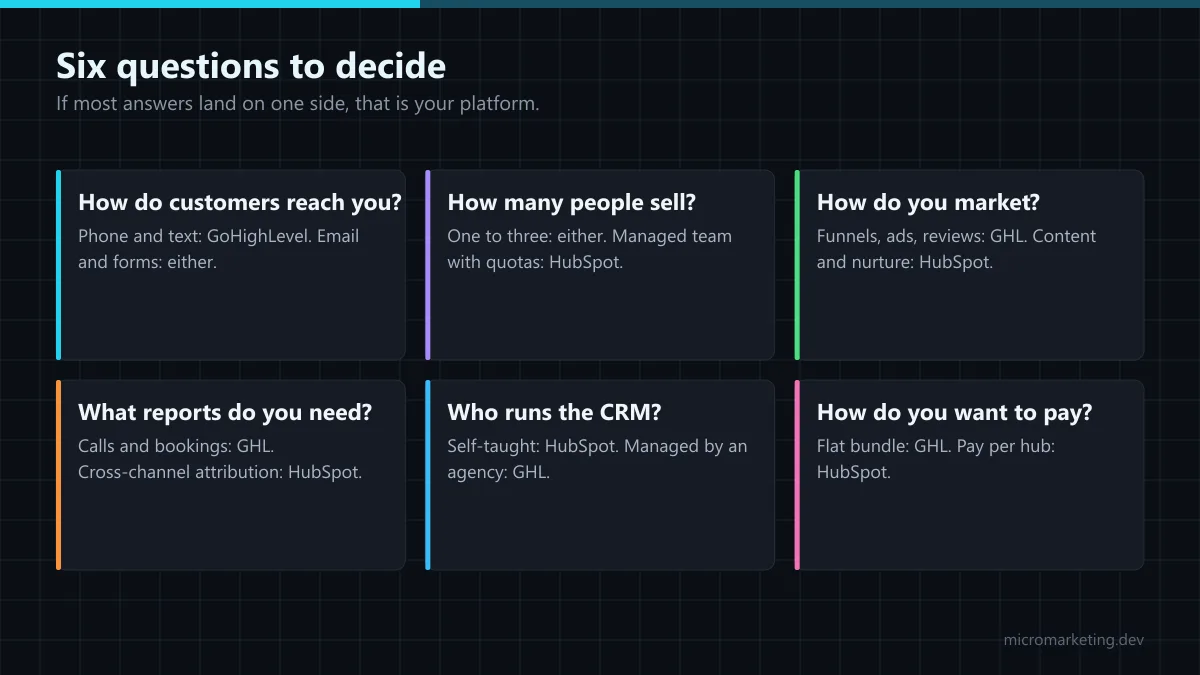
Answer these honestly:
- How do customers reach you? Mostly phone and text: GoHighLevel. Mostly email and web forms: either, with HubSpot slightly ahead.
- How many people sell? One to three with a simple process: either. A managed sales team with quotas and forecasts: HubSpot.
- How do you market? Funnels, ads, reviews and reminders: GoHighLevel. Content, SEO and long email nurture: HubSpot.
- What reports do you need? Calls, bookings, pipeline: GoHighLevel. Attribution across channels and objects: HubSpot.
- Who runs the CRM? You, self-taught: HubSpot. An agency or managed service: GoHighLevel.
- How do you want to pay? A flat bundle plus usage: GoHighLevel. Pay for the hubs you use: HubSpot.
If most of your answers land on one side, that’s your platform. If they split, the usual compromise is GoHighLevel for the customer-facing phone, text and booking side, with the business keeping any deeper reporting in a spreadsheet or BI tool.
We build and run CRMs for local and service businesses, and most of that work is on GoHighLevel because the bundle matches how those businesses actually operate: phone, text, calendar, follow-up. That’s what our Micro CRM automation service sets up and maintains. We also tell clients when HubSpot is the better fit, usually when they’re a B2B team selling through email and content with a sales manager who needs reporting. The point is to match the platform to how you win customers, not to win an argument about CRMs.
Frequently asked questions
Is GoHighLevel better than HubSpot for a small business?
For a local or service business that lives on phone calls, texts and appointments, GoHighLevel usually fits better because calling, SMS, calendars, funnels and automation are bundled at a flat price. For a business that sells through email and content, needs deep reporting or expects to grow into a larger sales and marketing team, HubSpot’s modular hubs usually fit better.
How is GoHighLevel priced compared with HubSpot?
GoHighLevel sells flat monthly plans that include the CRM, automation, calendars, funnels and messaging, with calling and texting usage billed on top. HubSpot offers a free CRM and then sells Marketing, Sales, Service and other hubs separately or as bundles, priced by tier and often by seats or contacts. Check each pricing page for current numbers.
Does HubSpot have built-in calling and texting like GoHighLevel?
HubSpot includes calling in its Sales Hub tiers and offers SMS through its marketing tools and integrations, with limits that depend on your plan. GoHighLevel has calling, two-way SMS, missed-call text-back and conversation inboxes as a core part of the platform. If texting customers is central to your business, test both against your real volume.
Can I migrate from HubSpot to GoHighLevel, or the other way?
Contacts, companies, deals and notes can be exported and imported between the two, usually by CSV or through an integration tool. Automations, email templates, pipelines and reports have to be rebuilt in the new platform. Plan the migration around the workflows, not just the contact list.
What is Micro CRM and how does it relate to GoHighLevel?
Micro CRM is our configured, managed setup of GoHighLevel for small and local businesses. It runs on the GoHighLevel platform, with pipelines, calendars, automations and messaging built for your business and maintained by us, so you get the platform without having to learn and administer it yourself.
Get a straight recommendation for your business
Tell us how you win customers today and what the CRM has to do. We’ll tell you which platform fits, what it would cost at your size, and what the setup involves. Book a free strategy call. If bookings are the core of your process, book an AI Appointment Assistant session with Tony. You can also read how our Micro CRM automation service builds and runs the platform for you.
Newsletter
Get growth playbooks in your inbox.
Practical SEO, PPC, automation, and web strategy from the Micromarketing team. No fluff, unsubscribe anytime.