Micromarketing is a marketing strategy that focuses effort on a small, tightly defined group of people, such as a single neighborhood, a narrow customer segment or even one individual, and tailors the offer and message to that group. Instead of one message for everyone, you build specific campaigns for specific people. It’s the opposite end of the scale from mass marketing, and narrower than niche marketing. This guide covers the definition, the main types, examples, pros and cons, and how AI makes micromarketing practical for small businesses.
Micromarketing definition
Wikipedia’s entry on micromarketing describes it as “a marketing strategy in which marketing and/or advertising efforts are focused on a small group of tightly targeted consumers.” It notes that the term first appeared in the UK marketing press in November 1988, describing the use of geodemographics in consumer marketing, and has come to cover strategies customized to local markets, to market segments or to individual customers.
In plain terms, micromarketing means:
- defining a very narrow audience, by place, by need, by behavior or by readiness to buy,
- tailoring the offer, message and channel to that audience,
- measuring the results for that audience on its own, not blended into everything else.
A note on the name: Micromarketing is also our agency’s name. We chose it because this focused, measurable approach is how we think marketing should work for small businesses.
Micromarketing vs mass marketing vs niche marketing
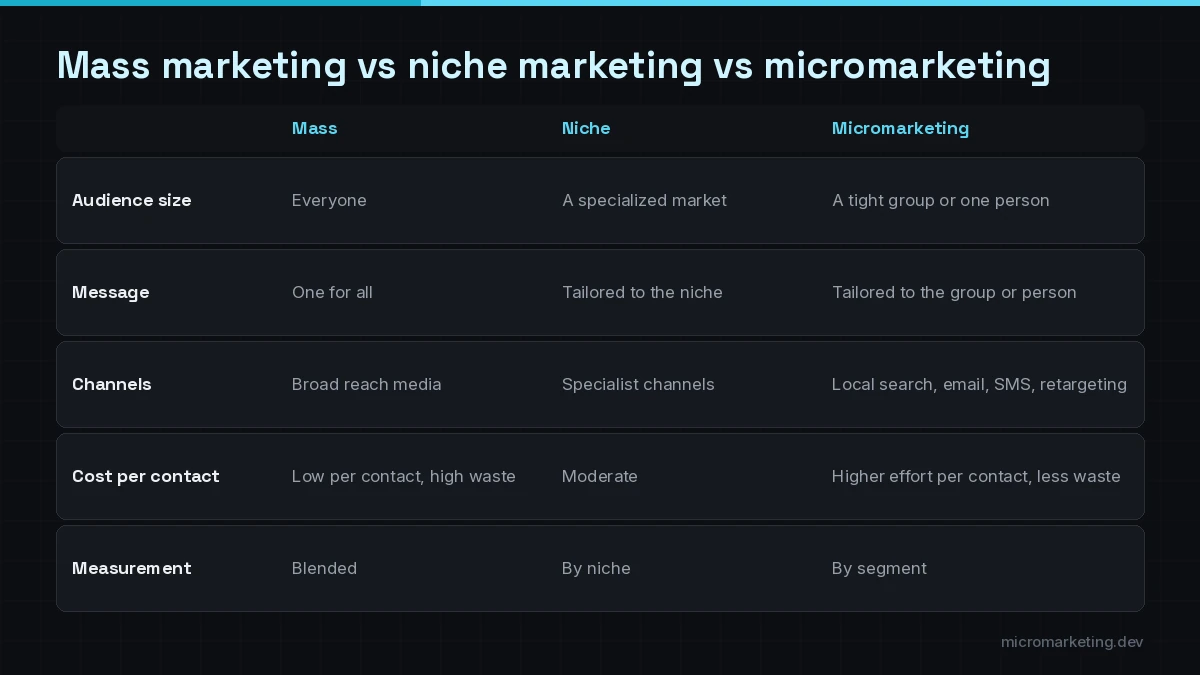
| Mass marketing | Niche marketing | Micromarketing | |
|---|---|---|---|
| Audience | Everyone | A specialized market | A tightly defined group or individual |
| Message | One message for all | Tailored to the niche | Tailored to the group or person |
| Example | A national TV ad | A brand for trail runners | An offer for trail runners within a few miles of a new store |
| Strength | Reach | Fit | Relevance |
| Watch out for | Waste | A limited market | Effort and data requirements |
Niche marketing picks a specialized market. Micromarketing goes a step further and tailors campaigns inside that market, down to a place, a moment or a person.
The main types of micromarketing
Local (geographic) micromarketing
Marketing to a specific city, neighborhood or radius around a location. For a local business, this is often where micromarketing starts: local search, a well-maintained Google Business Profile, neighborhood-specific landing pages and location-targeted ads. Google says local results are mainly based on relevance, distance and popularity, and its tips for improving local ranking start with a complete and accurate Business Profile.
Segment-based micromarketing
Marketing to a narrow segment defined by need or behavior, like first-time buyers, customers who bought one product but not another, or prospects who visited your pricing page twice.
Individual (one-to-one) micromarketing
Tailoring messages to a single customer based on what you know about them: their history, preferences and stage in the buying process. Personalized emails, product recommendations and sales follow-ups based on CRM data all fall here.
Moment-based micromarketing
Reaching people at a specific moment, like right after they book, after a service visit, when a renewal is due, or when weather or a local event changes what they need.
Micromarketing examples
These are illustrative examples, not client case studies:
- A dental practice builds a separate landing page and ad campaign for each nearby neighborhood it serves, with directions, parking details and local reviews on each.
- A home services company runs a campaign only for past customers whose equipment is due for maintenance, with a reminder and a booking link.
- A B2B software company sends different follow-up sequences to prospects depending on which feature page they spent time on.
- A restaurant promotes its catering menu only to offices within a short delivery radius during the weeks before the holidays.
- An online store retargets shoppers who abandoned a specific product category with content about that category, not a generic discount.
Benefits and drawbacks
Benefits
- Relevance. Messages that fit the reader tend to get more attention.
- Less waste. You spend on people likely to care.
- Clearer measurement. Small, defined audiences make it easier to see what works.
- Stronger local presence. Especially valuable for businesses that serve a specific area.
Drawbacks
- More work per campaign. Many small campaigns take more effort than one big one.
- Data requirements. You need clean customer and location data, and permission to use it.
- Harder to scale manually. Historically, this was the main barrier for small teams.
- Privacy responsibilities. Personalization has to respect consent and privacy rules.
How to build a micromarketing strategy
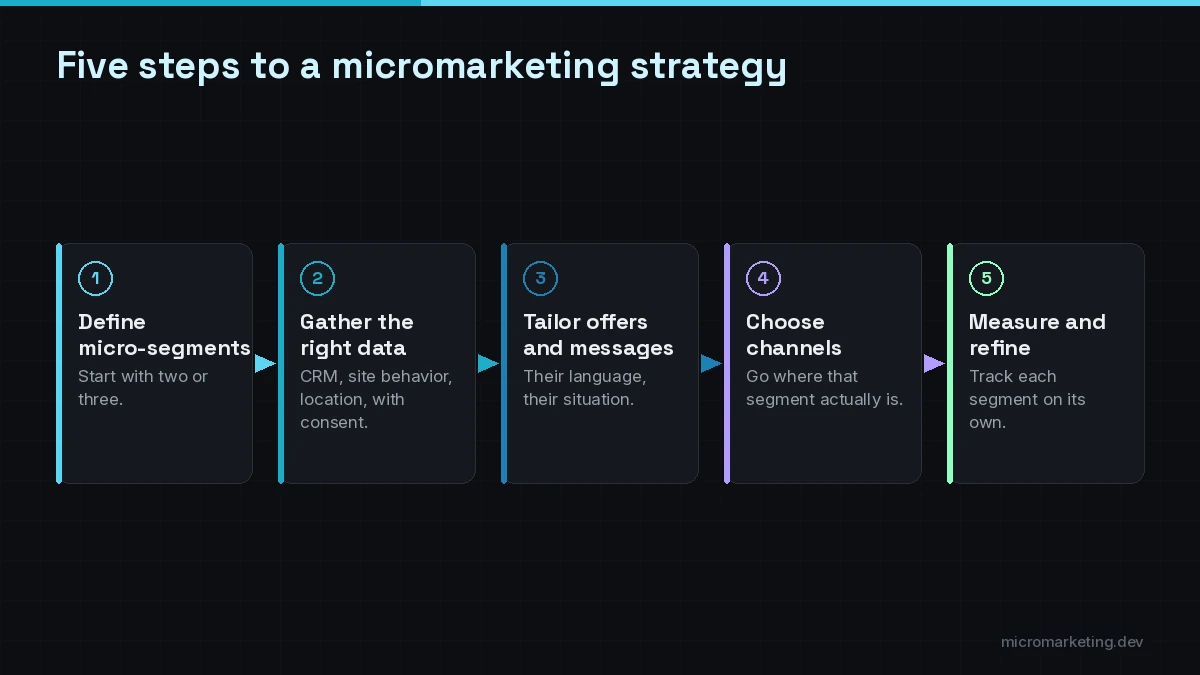
- Define your micro-segments. Start with two or three: a location, a customer behavior or a buying stage.
- Gather the right data. CRM records, website behavior, purchase history and location, collected with consent.
- Tailor the offer and message. What does this group need to hear? Use their language and their situation.
- Choose the channels. Local search, email, SMS, retargeting, paid social: go where that segment actually is.
- Measure and refine. Track each segment separately, keep what works and cut what doesn’t.
Common micromarketing mistakes
- Too many segments at once. Start with two or three you can serve well, then add more.
- Personalization without permission. Use data customers expect you to use, collected with consent, and respect opt-outs.
- Tailored ads, generic landing pages. If the ad speaks to a neighborhood or a need, the page it leads to should too.
- Blended reporting. If every segment rolls into one dashboard number, you can’t tell which segment is working.
- Set and forget. Segments change as customers move, buy and churn, so review them regularly.
How AI makes micromarketing practical
The traditional drawback of micromarketing was effort: every segment needed its own copy, its own list and its own follow-up. AI and automation change that:
- Segmentation. Automations can group contacts by behavior, location or stage as data comes in, rather than in quarterly list pulls.
- Tailored content at scale. AI can draft versions of an email, ad or landing page section for each segment, which a person then reviews and approves.
- Timely follow-up. Workflows can trigger the right message at the right moment, like after a booking, a site visit or a service date.
- Conversation. AI assistants on your website, SMS or WhatsApp can answer questions in context and pass qualified leads to your team.
Human judgment still matters. Someone should decide the segments, approve the messages and keep an eye on privacy and accuracy.
How we put micromarketing to work
Our digital marketing services connect SEO, paid media, content, email, analytics and retargeting around tightly defined audiences, so each campaign has a clear segment and a clear measure of success. Our AI automation services handle the segmentation, follow-up and assistants that make it scale. For businesses in South Florida, local micromarketing starts with search, and our SEO services in Boca Raton focus on exactly that. If you run an agency, see how to grow an AI automation agency’s brand awareness, and for ideas on what to automate first, read the manual tasks worth automating in 2026. If you want the segments, data and follow-up connected end to end, our digital marketing team can map it with you.
Frequently asked questions
What is micromarketing in simple terms?
Micromarketing means focusing your marketing on a small, tightly defined group, like a neighborhood, a narrow customer segment or one customer, and tailoring the message and offer to them.
What is the difference between micromarketing and macromarketing?
Macromarketing looks at marketing at the scale of a whole market or society: broad audiences and big-picture effects. Micromarketing focuses on small, specific groups or individuals and tailors campaigns to them.
What are examples of micromarketing?
Neighborhood-specific landing pages for a local business, maintenance reminders sent only to past customers who are due, follow-up emails based on the page a prospect viewed, and promotions limited to a small delivery radius.
Is micromarketing good for small businesses?
Yes, especially for local businesses. It concentrates a limited budget on the people most likely to buy. AI and automation now handle much of the extra work that used to make micromarketing hard for small teams.
How does AI help with micromarketing?
AI and automation can segment contacts as data arrives, draft tailored versions of messages for review, trigger follow-ups at the right moment and power assistants that answer questions in context.
Put micromarketing to work for your business
Tell us who your best customers are and where they are. We’ll help you define the segments, connect the data and build campaigns that speak to each one. Book a free strategy call. The first consult is free.
Newsletter
Get growth playbooks in your inbox.
Practical SEO, PPC, automation, and web strategy from the Micromarketing team. No fluff, unsubscribe anytime.