
AI & Automation
AI automation services for small and mid-sized businesses
One team for both sides of AI and automation: AI systems that reason over your data, and automations that move work between your tools, built with context, approvals, and measurement.
automation.run
Human-gated agent
AI workflow
Intake
Reason
Approve
Execute
AI automation guide
Practical ways to automate work without losing control.
AI-powered automation helps remove repetitive work, reduce errors, and create faster handoffs across support, marketing, ecommerce, reporting, and internal operations.
Book a free strategy callSupercharge your business with AI and automation.

Work faster, smarter, and better
Automate repetitive tasks, streamline manual workflows, and give your team more time for high-value work.
Improve accuracy and speed by reducing manual errors and increasing task completion consistency.

Save time and reduce costs
Use AI-driven workflows for data entry, customer follow-up, reporting, approvals, and routine operations.
Lower operational overhead while keeping teams focused on growth, customer experience, and strategic priorities.
AI automation services we offer
We design automation around real business workflows, not generic demos or disconnected scripts. Start with the service closest to the work you want off your plate.
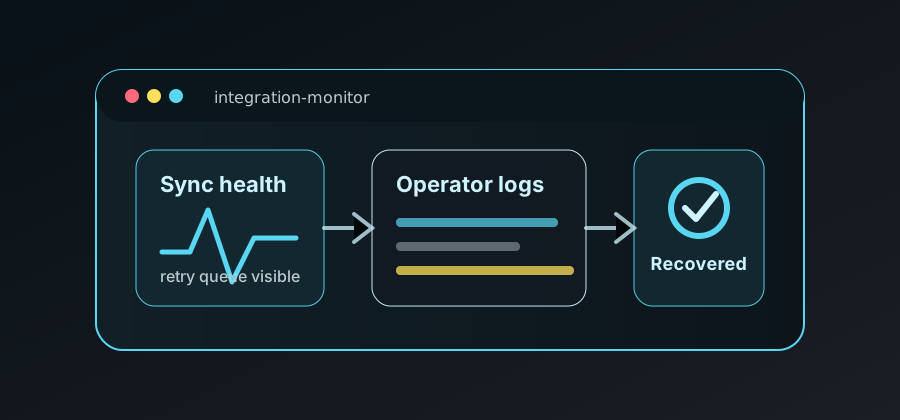
AI agent development service
Custom AI agents that research leads, update your CRM, draft replies and hand off to your team, with approvals and logs built in.

AI receptionist software
An AI receptionist that answers your business line 24/7, books appointments into your calendar and routes the hard calls to your team.

AI voice agent services
Custom voice agents for support lines, outbound follow-up and appointment reminders, with live transfer to a person anytime.

n8n consultant
n8n workflows designed, built and hosted for you, documented and monitored, on n8n Cloud or your own server.

AI chatbots for business
Chatbots trained on your own content for your website, SMS, WhatsApp and Messenger, with lead capture and human handoff.

AI workflow automation services
CRM and back-office automation across the tools you already use, with approvals, error alerts and reporting.
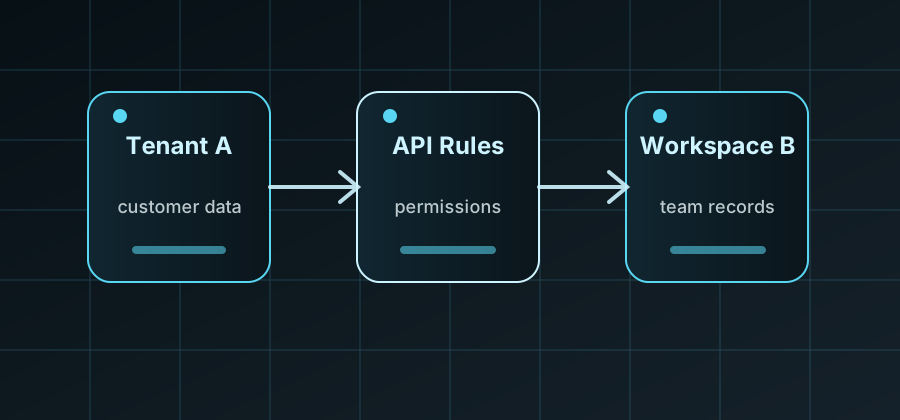
Custom AI copilots and data
Private copilots that answer from your own documents, plus the tracking and dashboards that show what is working.
AI-powered solutions that improve revenue and customer experience.

24/7 customer support
Respond to inquiries, guide users, handle order tracking, and reduce support load with AI chatbots and messaging workflows.

Personalized recommendations
Use behavioral and purchase data to recommend relevant products, increase cross-sell opportunities, and lift average order value.

Inventory and sales forecasting
Predict demand, optimize inventory, prevent stockouts, and reduce unnecessary carrying costs with AI-assisted forecasting.
Customer data insights
Turn browsing behavior, purchase history, and campaign activity into segments, insights, and actions that improve ROI.

Marketing automation
Automate email, SMS, PPC, social media scheduling, campaign reporting, and cross-channel follow-up from one connected system.
AI automation: how it works.
Step 1: Discovery and planning
We analyze your business needs and identify tasks that can be improved with AI, automation, integrations, or better workflow design.
Technologies- Miro for collaboration
- Notion for planning
Step 2: Development and integration
We implement AI assistants, automation scripts, data workflows, browser automations, or integrations tailored to your use case.
Technologies- OpenAI for conversational AI
- UiPath and Puppeteer for process automation
Step 3: Testing and optimization
We test accuracy, reliability, edge cases, permissions, and scalability before the automation becomes part of daily operations.
Technologies- Jest and Playwright
- CI/CD tools for deployment
Step 4: Deployment and support
We deploy, monitor, support, and improve the system so it keeps delivering value as your business changes.
Technologies- AWS, Azure, or Google Cloud
- Analytics tools for insight
Frequently asked questions.
What is AI and automation?
AI and automation use software, models, and workflows to streamline repetitive tasks, improve decision-making, and enhance customer experiences.
What tasks can be automated?
Common tasks include data entry, email follow-up, customer communication, workflow routing, predictive analytics, chatbots, ecommerce operations, payroll, scheduling, approvals, and reminders.
Do you offer custom AI solutions?
Yes. We build custom AI assistants, chatbots, recommendation systems, predictive analytics workflows, and automation layers tailored to the business need.
Can you connect AI to existing systems?
Yes. We integrate AI and automation with CRMs, ERPs, ecommerce platforms, databases, marketing tools, and internal systems.
How do you keep AI accurate?
We ground AI in relevant business context, test outputs, monitor performance, add review gates, and use safeguards to reduce unreliable responses.
What platforms do you use?
We use tools such as OpenAI, Claude, UiPath, Zapier, Microsoft Power Automate, Puppeteer, cloud services, analytics tools, and custom code depending on the workflow.
More of our services.
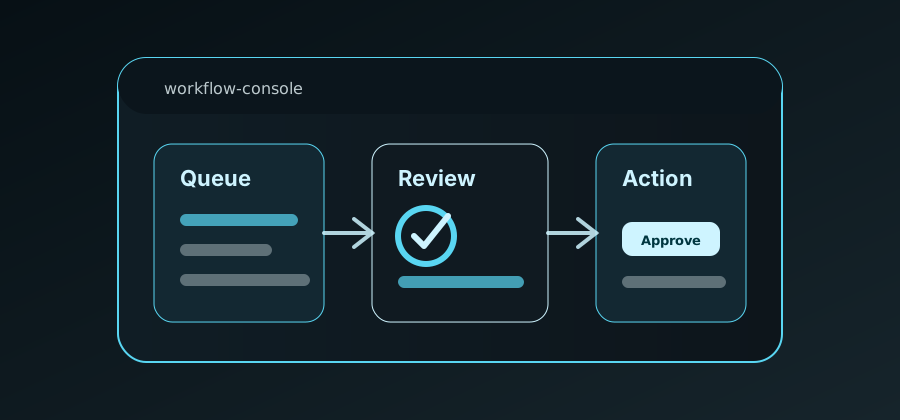
Apps & Integration
Custom apps, dashboards, APIs, and integrations that connect the tools behind your automation stack.
Explore apps & integration
Website Development
Fast, responsive, conversion-ready websites that connect to your CRM, analytics, and automation systems.
Explore website development
Digital Marketing
SEO, PPC, social campaigns, content, and analytics connected to measurable pipeline and revenue outcomes.
Explore digital marketingAI & Automation
AI and automation that actually reaches production.
AI assistants
Copilots for daily work
Draft, summarize, classify, research, enrich, and prepare outputs with business-specific context and human review.
Agents
Tool-using workflows
Agentic workflows that gather context, call APIs, create drafts, route decisions, and stop for approval at the right moments.
Operations
CRM and communication automation
Lead routing, email/SMS follow-up, intake processing, quote prep, reminders, and internal notifications connected to your systems.
Safety
Controls before autonomy
Permissions, prompts, logs, dry-runs, review queues, and escalation paths so AI is useful without becoming reckless.
Operating model
Not just pages — a complete digital operating layer.
Step-by-step build path
01 Find the task loop
Choose a repetitive high-value workflow where AI can reduce time, improve quality, or speed up response.
02 Ground the system
Connect the workflow to the right data, prompts, tools, templates, permissions, and review points.
03 Measure and expand
Track time saved, output quality, cost, failure modes, and adoption before scaling to more workflows.
Deliverables
What leaves the workshop ready to use.
AI copilots Agent workflows Prompt systems RAG search CRM automation Review queues Usage reporting
Quality gates
Built with proof points, not vague promises.
AI outputs are grounded in business context instead of generic prompt tricks.

Risky actions are approval-gated and observable before they touch customers or systems.

Automation is designed as an operating workflow, not as a pile of disconnected scripts.
Local
AI automation near you in Boca Raton and South Florida
Looking for AI automation near you? Micromarketing is based in Boca Raton, FL, and we work with businesses across South Florida, including Boca Raton, Delray Beach, Deerfield Beach, Pompano Beach and Fort Lauderdale, and the rest of Palm Beach and Broward counties. Being local means we can meet in person when it helps, walk through your front desk or back office to see how work really moves, and keep the conversation in plain language.
Most of the build happens remotely, so we also work with teams across the US. Whether you need an AI receptionist for a busy office, an n8n workflow for your back office or an AI agent for sales follow-up, we start with one process and the result you want from it.
Platforms
Platforms we build on
We pick the tools for each job and aren't tied to one vendor. Platforms we build on include OpenAI (Agents SDK / AgentKit), Grok (xAI), Meta / WhatsApp Business, open-source agents such as Hermes Agent, and n8n for orchestration, along with the CRM and business tools you already use.
For phone work, we build AI receptionists and voice agents on Twilio, Vapi, GoHighLevel and others.
Capabilities
Explore AI and automation in depth.
AI Agent Development
Custom AI agents that research, qualify leads, update your CRM, and hand off to your team.
Learn more about AI Agent Development →AI Receptionist
A 24/7 AI phone receptionist that answers, books appointments, and routes calls.
Learn more about AI Receptionist →AI Voice Agents
Inbound and outbound voice agents for support, follow-up, and reminders.
Learn more about AI Voice Agents →n8n Automation
n8n consulting, builds, self-hosting, migrations, and maintenance.
Learn more about n8n Automation →Assistants & Chatbots
Knowledge-grounded chat for your website, SMS, WhatsApp, and Messenger, with human handoff.
Learn more about Assistants & Chatbots →Workflow Automation
Process mapping, CRM operations, and reliable automation across your existing tools.
Learn more about Workflow Automation →Custom AI & Data
Internal copilots, private retrieval, embedded AI, tracking, and operational dashboards.
Learn more about Custom AI & Data →
Next step
Ready to build a cleaner growth system?
Tell us what you want to improve and we will map the fastest useful path from strategy to shipped execution.
Book a free strategy callAI
AI Consulting and Custom AI Development in Boca Raton, FL
We help you decide where AI is worth using, then build it: copilots, agent workflows, retrieval over your own data, and AI-powered product features, with people approving the steps that matter. Looking for rule-based workflow automation instead? See business process automation, or the full AI & automation services.
01 Context Docs + data
02 AI reasoning Copilot + agents
03 Review gates Human control
04 Outputs Tools + products
Custom assistant bots
AI assistants we deploy
We build and deploy custom AI assistants using Grok, xAI's model, alongside OpenAI and Claude. A Grok Bot — a custom assistant powered by Grok — can take repetitive work off your team's plate: answering common questions, drafting, summarizing, and routing requests.
We connect assistants to your approved knowledge and tools, with human review and handoff where needed. Grok is a product of xAI; Micromarketing is an independent agency.
Explore assistants & chatbotsAI systems, not experiments
Copilots, agent workflows, and retrieval over your own data.
AI systems, not experiments
Micromarketing designs practical AI systems using LLMs, assistants, chatbots, retrieval, and automation patterns that fit real business workflows.
Workflow-first Grounded in your data Human review built in Measured after launch
AI capabilities
From internal copilots to AI-powered products.
AI copilots
Internal assistants for drafting, research, support, sales prep, reporting, summarization, and task acceleration.
Agent workflows
Goal-driven workflows that gather context, call tools, route outputs, and keep humans in control at key checkpoints.
Knowledge and retrieval
RAG, structured knowledge bases, document search, content QA, and business-specific memory for more accurate outputs.
AI product features
Embed generation, classification, recommendations, enrichment, and automation into customer-facing apps and dashboards.
Operational safeguards
Context, control, and measurement are part of the build.
AI becomes dependable when the system knows what it can use, when a person must review the work, and how success or failure will be measured.
Grounded context
We connect AI systems to the right business data, documents, workflows, and permissions instead of relying on generic prompts.
Human checkpoints
Approvals, review queues, logs, and escalation paths keep AI useful without letting it silently make risky business decisions.
Measurable outcomes
We track time saved, response quality, conversion lift, cost per task, and failure modes so the system improves after launch.
How we build it
A clear path from promising idea to reliable AI system.
Each stage produces something your team can review, test, and use to make the next decision with confidence.
Map the highest-value use case
We document the workflow, users, decisions, source data, current effort, and failure cost before recommending an AI approach.
- Workflow and data map
- Success baseline
- Risk and permission boundaries
Prove quality with real examples
We build the smallest useful interface, prompt and retrieval path, then evaluate it against representative business scenarios.
- Working prototype
- Evaluation examples
- Fallback behavior
Connect tools and human review
The approved workflow is integrated with the systems it needs while permissions, review gates, logs, and operator controls are added.
- System integrations
- Approval checkpoints
- Usage and quality analytics
Measure, improve, and expand
We monitor quality, adoption, speed, cost, and exceptions so the system improves from evidence instead of assumptions.
- Performance dashboard
- Feedback loop
- Expansion roadmap
Applied AI systems
Four practical ways AI can show up in daily operations.
Support assistants
Answer customer questions, summarize cases, route requests, and keep human teams focused on exceptions.
Workflow automation
Move data between forms, CRMs, dashboards, approvals, and reports without repetitive manual handoffs.

Knowledge retrieval
Search documents, SOPs, product details, policies, and internal notes with business-specific context.
Revenue intelligence
Turn ecommerce, campaign, sales, and customer behavior data into recommendations and next-best actions.

Ready to make AI operational?
Let’s turn your best AI use case into a reliable workflow.
We’ll identify the highest-value path, required data, safeguards, and build plan.
Book a free strategy call